
M.A.D. PRO
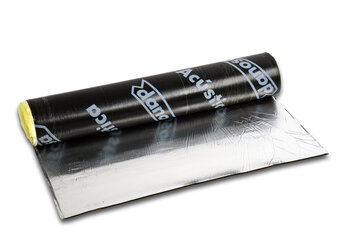
Aluminized bituminous sheet for acoustic insulation.
Product variations:

 EPD S-P-01923
MAD PRO is a bituminous acoustic sheet reinforced with mineral loads and an aluminized coating. Its mass provides excellent acoustic insulation, acting as an anti-resonant element on one side, as a plastic element between rigid elements, or as a membrane resonator between spring elements. Additionally, it is characterized by its excellent fire performance (bs1d0), functioning as a vapor barrier and as a thermal reflector in cavities.
Scope
- Industrial roofs with acoustic requirements.
- It is used in industrial insulation as an anti-resonant material, providing acoustic mass to galvanised steel sheets.
- Between rigid elements, such as plasterboard, to improve low-frequency insulation, both on vertical and horizontal surfaces.
- Used between spring elements to increase the overall isolation of the treatment, significantly improving low frequencies.
- Acoustic solutions requiring an internal vapor barrier.
- Technical solutions with wood paneling.
- Acoustic solutions with perforated surface elements.
Advantages & Benefits
- By adhering to galvanised steel sheets, it improves the resonance of the sheet.
- By increasing the insulation at low frequencies, cavaties used can be kept to a minimal size.
- By increasing the mass of lightweight walls, a higher acoustic performance is achieved.
- It shifts the resonance frequencies of the rigid elements making the insulation stronger.
- Between insulators, it transforms acoustic energy into dynamics, improving insulation at low frequencies.
- Excellent performance in fire reaction testing (bs1d0).
- Acts as a vapor barrier.
- In the cavity, it shows thermo-reflective behavior.
- Allows its combination with perforated or porous surface elements to optimize acoustic insulation.
- The membrane provides the system with a fire reaction of Bs1d0 without the need for covering.
Instruction for Use
Preliminary OperationsIn systems between panels: Following the instructions and recommendations of the manufacturers of plasterboard, the framework will be fixed to the substrate, including sealing strips.
On the ceiling, first, the mechanical resistance of the damper system and the framework must be checked.
Next, the first plasterboard sheet is fixed to the supporting structure using self-tapping screws.
Ensure that this sheet is dry, clean, and free from foreign bodies. In direct systems: Following the instructions of the plasterboard manufacturers, it is recommended to install sealing strips around the perimeter of the framework.
Install directly with staples, contact adhesive, or using self-adhesive (in the AA version).
Lift the compound (board + membrane) and fix directly to the supporting structure using plasterboard fixing systems.
Avoid joints greater than 1 mm between sheets. Installation of Danosa Acoustic Membrane M.A.D. PRO:Due to its good fire reaction performance, the membrane can be installed directly after perforated and/or decorative solutions.For typical plaster partition solutions, the following points are recommended:On walls
Start by cutting full pieces of M.A.D. PRO to the same height as the partition. Offcuts will be used for smaller sections or finishing.
It can be applied with mechanical fixing systems or with bonding systems.
A. Mechanical Fixing
Once the piece is placed squarely with the surfaces, one person will hold it at the top, while another begins stapling the top. Then, one person releases and the other continues applying staples.
To maintain the continuity of the membrane, the M.A.D. PRO has a rebate on the edges that must be aligned.
The second plasterboard sheet is screwed to the supporting structure using self-tapping screws.
It is important to stagger the joints with the first sheet to avoid leaks. B. Adhesive
A layer of contact adhesive Glue-Dan Acustic 1 is applied to the first plasterboard sheet using a short-pile roller. The recommended coverage for perfect adhesion is 125 g/m².
In the same way, and on a clean surface where the membrane has been placed, apply another layer of adhesive with the same coverage to the M.A.D. PRO.
Prepare the pieces and, after 15 minutes, begin installing the membrane.
Place the piece squarely with the surfaces and start adhering it from the top and from the joint with another membrane.
Press down to ensure there are no air pockets.
To maintain the continuity of the membrane, the M.A.D. PRO has a rebate on the edges that must be aligned.
Screw the second plasterboard sheet to the supporting structure using self-tapping screws.
It is important to stagger the joints with the first sheet to avoid leaks.
The total adhesive coverage per square meter is 250 g.On the ceiling
Start by cutting M.A.D. PRO pieces transversely to the roll at a distance of 1.2 m. This results in pieces of 1 x 1.2 m². Offcuts will be used for smaller sections or finishing.
It can be applied with mechanical fixing systems or with bonding systems following the same steps as described for walls.
It is possible to work directly on the ceiling by fixing the membrane to the first plasterboard sheet or, alternatively, work on the floor by applying the membrane to the second sheet.
In this latter case, after fixing the membrane with staples or adhesive, the membrane and second sheet are lifted using a mechanical lift.
This assembly is screwed to the primary-secondary ceiling structure using self-tapping screws.
It is important to stagger the joints with the first sheet to avoid leaks. Note: DPS: Acoustic Insulation Work Manual. Details of Specific Points.
On the ceiling, first, the mechanical resistance of the damper system and the framework must be checked.
Next, the first plasterboard sheet is fixed to the supporting structure using self-tapping screws.
Ensure that this sheet is dry, clean, and free from foreign bodies.
Install directly with staples, contact adhesive, or using self-adhesive (in the AA version).
Lift the compound (board + membrane) and fix directly to the supporting structure using plasterboard fixing systems.
Avoid joints greater than 1 mm between sheets.
Start by cutting full pieces of M.A.D. PRO to the same height as the partition. Offcuts will be used for smaller sections or finishing.
It can be applied with mechanical fixing systems or with bonding systems.
A. Mechanical Fixing
Once the piece is placed squarely with the surfaces, one person will hold it at the top, while another begins stapling the top. Then, one person releases and the other continues applying staples.
To maintain the continuity of the membrane, the M.A.D. PRO has a rebate on the edges that must be aligned.
The second plasterboard sheet is screwed to the supporting structure using self-tapping screws.
It is important to stagger the joints with the first sheet to avoid leaks.
A layer of contact adhesive Glue-Dan Acustic 1 is applied to the first plasterboard sheet using a short-pile roller. The recommended coverage for perfect adhesion is 125 g/m².
In the same way, and on a clean surface where the membrane has been placed, apply another layer of adhesive with the same coverage to the M.A.D. PRO.
Prepare the pieces and, after 15 minutes, begin installing the membrane.
Place the piece squarely with the surfaces and start adhering it from the top and from the joint with another membrane.
Press down to ensure there are no air pockets.
To maintain the continuity of the membrane, the M.A.D. PRO has a rebate on the edges that must be aligned.
Screw the second plasterboard sheet to the supporting structure using self-tapping screws.
It is important to stagger the joints with the first sheet to avoid leaks.
The total adhesive coverage per square meter is 250 g.
Start by cutting M.A.D. PRO pieces transversely to the roll at a distance of 1.2 m. This results in pieces of 1 x 1.2 m². Offcuts will be used for smaller sections or finishing.
It can be applied with mechanical fixing systems or with bonding systems following the same steps as described for walls.
It is possible to work directly on the ceiling by fixing the membrane to the first plasterboard sheet or, alternatively, work on the floor by applying the membrane to the second sheet.
In this latter case, after fixing the membrane with staples or adhesive, the membrane and second sheet are lifted using a mechanical lift.
This assembly is screwed to the primary-secondary ceiling structure using self-tapping screws.
It is important to stagger the joints with the first sheet to avoid leaks.
Indications and Important Recommendations
- For very heavy ceilings, it is recommended to use a ceiling grid system consisting of primary and secondary profiles. This system helps to spread loads if any shock absorber anchorage point breaks. See SPD 4.3.
- The ceiling dampers are always anchored to the floor joist or a reinforcing construction element. See SPD 4.2
- The facade cladding in a building must end at the dividing wall between different users. See SPD 2.1
- In dry wall cladding for heights over 4 m, we recommend the use of elastic fasteners. See SPD 2.5
- Gypsum plasterboards must always be anchored to the galvanised steel auxiliary structure, never use plate-plate screws.
- Partition walls must be plastered with at least 1 cm. See SPD 3.
- Partition walls should not be anchored to structural elements (except for roofs in dwellings) such as pillars and facades. In order to maintain the stability of the system, the tiling element must be bonded to the internal floating partition walls.
- It is not possible to perforate with installations in the proposed solution in commercial premises located in tertiary buildings or commercial ground floors in residential buildings. See SPD 2.3 and SPD 4.4.
- In solutions with perforated finishes or in cavities, the aluminized side helps to promote the reflection of heat towards the interior of the room.
Handling, storage and preservation
- Consult the product safety datasheet.
- According to the EEC directives on labelling hazardous substances (GefStoffV), special labelling is not required.
- Material at room temperature can be handled without special precautions as it is stable at room temperature.
- The product, as such, is not classified as hazardous for transportation.
- Under normal conditions, the product is not hazardous.
- In application, the appropriate measures must be taken when handling machinery (mechanical fixing with staples) or for the application of adhesives via solvent.
- Temperatures above 80ºC alter the material and accelerate its degradation.
- Product components do not degrade significantly over time
- Keep away from flames and sources of heat.
- It is marketed as rolled sheets in coil form and transported loose or grouped on pallets, and is stable at room temperature and during transportation.
Notice
- The information contained in this document and any other advice provided, are given in good faith, based on DANOSA's current knowledge and experience when products are properly stored, handled and applied, in normal situations and in accordance with the recommendations of DANOSA. The information applies only to the application (s) and the product (s) to which reference is expressly made. In case of changes in the parameters of the application, or in case of a different application, consult the DANOSA Technical Service before using the DANOSA products. The information contained herein does not exonerate the responsibility of the building agents to test the products for the application and intended use, as well as their correct application in accordance with current legal regulations. The product images used in our communications are indicative and may differ slightly in color and aesthetic appearance in relation to the final product.Orders are accepted in accordance with the terms of our current General Sales Conditions.DANOSA reserves the right to modify, without prior notice, the data reflected in this documentation.Website: www.danosa.com E-mail: info@danosa.com Telephone: +34 949 88 82 10
Presentation
- Length (cm): 450
- Width (cm): 100
- Thickness (mm): 5.4
- Surface (m²): 4.5
- Product code: 610045
Technical Data
| Concept | Value | Standard |
|---|---|---|
| Mass per unit area (nominal) (kg/m²) | 10 | EN 1849-1 |
| Improvement to airborne noise on laminated gypsum board partition, ΔR (dBA) | 6 | EN 140-16 |
| Insulation improvement at 125 Hz (between rigid elements) (dB) | >10 | EN 140-16 |
| Poisson coefficient | 0.48 | - |
| Reaction to fire | Bs1d0 | EN 13501-1 |
| Longitudinal tensile strength (N / 5cm) | 758 | EN 12311-1 |
| Transverse tensile strength (N / 5cm) | 388 | EN 12311-1 |
| Resistance to tearing (nail shank) (N) | 167±22 | EN 12310-1 |
| Thickness tolerance (%) | 10% | EN 823 |
| Mass tolerance (%) | 10 | EN 1849-1 |
| Tolerance Length and Width (%) | 5% | EN 822 |
Standards and Certification
- The sound certifications are the result of tests in an approved laboratory.
- *For any questions about information on the tests, please consult our Technical Department.
Environmental Information
| Concept | Value | Standard |
|---|---|---|
| Volatile organic compounds (COV's) (µg/m³) | 50 | ISO 16000-6:2006 |
| Content of recycled raw material (%) | 22% | - |
| Post-consumer recycled content (%) | 6060 | - |
| Manufactured in | Fontanar - Guadalajara (España) | - |